Affiliate Disclosure: This is an independent review site. We may earn referral fees from companies featured on this page. This does not affect our editorial ratings. Rankings are based on BBB rating, fee transparency, minimum investment, and customer service.
Editorial TeamOur Editorial TeamFinancial Advisor • 13 years in retirement portfolio management
Last updated: May 2026 | Next review: August 2026 • Sources: IRS Publication 590-B (2025), SEC Investor Alert on Self-Directed IRAs (2022), FINRA.org, World Gold Council Demand Trends 2025
2026 Gold IRA Rollover Guide

Gold IRA Rollover Guide

Gold IRA rollover guide qualifies under IRC Section 408(m), allowing employer-plan dollars to move into IRS-approved bullion at IRS-mandated 99.5% gold fineness. Transfers wrap up in 14-21 business days end-to-end, and Goldco ranks among the top three at $10,000 minimum with BBB A+ rating as of 2026.

A Gold IRA rollover transfers 401(k) or IRA funds into a Self-Directed IRA holding IRS-approved physical gold under IRC §408(m)(3) — zero taxes when executed via direct trustee-to-trustee transfer.

Expert Picks

Top Gold IRA Companies 2026

Compare the leading precious metals IRA providers

Rank
Company
Rating
Minimum
Key Features
Action
1
Best Overall
4.9/5 BBB: A+
$50,000 Minimum
Lifetime SupportPrice Match GuaranteeFree Gold IRA Kit
2
Best Buyback
4.8/5 BBB: A+
$25,000 Minimum
A+ BBB RatingExcellent ReviewsWhite Glove Service
3
Best for Beginners
4.7/5 BBB: A+
$10,000 Minimum
Low MinimumFast SetupPrice Protection
4
Most Experience
4.6/5 BBB: A+
$10,000 Minimum
20+ Years ExperienceEducational ResourcesDiverse Options
5
Royal Survival Packs
4.5/5 BBB: A+
$20,000 Minimum
Texas DepositoryNo Quibble PolicyIRA Specialists
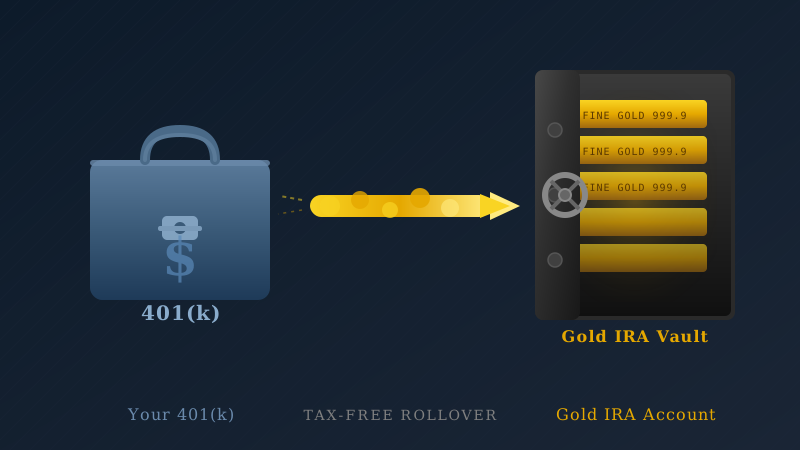
Gold IRA rollover process - 401k to Gold IRA

A Gold IRA rollover transfers funds from a 401(k), traditional IRA, or eligible employer plan into a self-directed IRA (SDIRA) holding IRS-approved physical gold — with no taxes or penalties owed when executed correctly. The IRS gives you 60 calendar days to complete an indirect rollover and permits only one rollover per 12-month period per account; a direct trustee-to-trustee transfer has neither restriction. This guide covers eligibility, the step-by-step rollover process, IRS fineness requirements, fee structures (setup fees of $50–$150, annual custodian fees of $75–$300, and storage fees of $100–$300/year), and the compliance rules that determine whether your rollover is tax-free or taxable.

A Gold IRA rollover shields your retirement portfolio from inflation and equity market downturns by converting paper assets into IRS-approved physical precious metals that retain intrinsic value independent of equity markets, currency devaluation, or bond defaults. A Gold IRA accepts rollovers from 401(k)s, 403(b)s, traditional IRAs, Roth IRAs, SEP IRAs, and SIMPLE IRAs — covering nearly every tax-advantaged retirement vehicle available to US investors.

What Is a Gold IRA?

A Gold IRA is a Self-Directed IRA (SDIRA) authorized under IRC §408(m)(3) that holds IRS-approved physical precious metals — including American Gold Eagles, American Buffalo coins, Canadian Maple Leafs, Austrian Philharmonics, and .995+ fineness bullion bars from LBMA-approved refiners like PAMP Suisse — inside a tax-advantaged retirement account. gold silver ira Unlike traditional IRAs that typically offer mutual funds, bonds, and stocks, a Self-Directed IRA can own physical precious metals — namely IRS-approved gold bullion, specific gold coins such as American Gold Eagles, and certain silver, platinum, and palladium coins and bars. gold ira rollover vs transfer A precious metals IRA is still an IRA: contributions, distributions, required minimum distribution (RMD) rules, and tax implications all follow IRS rules depending on whether you open a Traditional IRA or Roth IRA version. A Gold IRA lets investors hold tangible assets for diversification, inflation hedging, and risk management during economic uncertainty and market volatility. Gold IRAs became legal under the Taxpayer Relief Act of 1997, which authorized IRAs to hold specific bullion and coins meeting fineness standards. Today investors use a Gold IRA to complement paper assets and gold stocks held in a brokerage account.

Gold IRA Rules at a Glance

  • A qualified Gold IRA custodian (a bank, trust company, or IRS-approved firm) opens and administers your Gold IRA account.
  • Only IRS-approved metals qualify under IRC §408(m)(3): gold bullion at .995+ fineness, silver at .999+, platinum and palladium at .9995+, plus approved coins like American Gold Eagles, American Buffalos, Canadian Maple Leafs, and Austrian Philharmonics. Numismatic coins, proof coins outside the IRS program, and collectibles are disallowed under the collectibles exclusion.
  • A Gold IRA vaults all physical metals at an IRS-approved depository (Delaware Depository, Brinks Global Services, or IDS of Texas) and forbids the account holder from taking personal possession while assets remain in the IRA.
  • Transfers and rollovers must follow strict Gold IRA rollover rules and IRS rules. You can use a direct rollover, a trustee-to-trustee transfer, or an indirect rollover with limitations.
  • The one-rollover-per-year rule applies to indirect IRA-to-IRA rollovers within any 12-month period. Trustee-to-trustee transfers are exempt from this limit.
  • Traditional IRA distributions are taxed as ordinary income in retirement; Roth IRA qualified distributions are tax-free because earnings grow tax-free after the holding period and age requirements.
  • IRC §4975 prohibits self-dealing and other prohibited transactions — such as home storage of IRA metals or buying metals from a disqualified person — which can disqualify the entire account.

Gold IRA Rollover vs Transfer: Know the Difference

A rollover moves funds through you (60-day window, one-per-year limit); a trustee-to-trustee transfer moves them directly between custodians with no deadline and no limit — and is the safer choice for most investors.

When you move retirement funds into a Gold IRA, you choose between a rollover or a transfer. Each route carries different IRS deadlines, tax-withholding rules, and frequency limits — pick the wrong one and you can owe ordinary income tax plus a 10% penalty.

Direct Rollover

A direct Gold IRA rollover routes funds straight from the plan administrator to your new Gold IRA custodian — bypassing you entirely. Because the funds never touch your hands, there is no tax withholding and no risk of accidental taxable income. For a 401 k to gold ira move (often called k to gold ira or 401 k to gold), a direct rollover is usually the cleanest and most secure method to preserve tax deferred status.

Indirect Rollover

An indirect rollover happens when you receive a distribution from a retirement plan or existing ira and then personally deposit the money into a new gold ira within 60 days. With a 401 k or similar plan, mandatory tax withholding often applies (commonly 20%), and you must replace the withheld amount from other funds to avoid creating taxable income. Since the only one rollover rule applies to indirect transfers between iras in a 12-month period, and the 60-day clock is strict, many investors avoid this route unless necessary.

Direct Transfer (Trustee-to-Trustee)

A direct transfer—often called a gold ira transfer—moves funds from one ira to another ira of the same tax type without any distribution to you. Your existing ira custodian sends money directly to your new gold ira custodian. This approach has no tax withholding, no 60-day deadline, and no limitation under the only one rollover rule. If you are moving funds from an existing traditional ira, a direct transfer is typically the safest and simplest path.

The 60-Day Rollover Rule (IRS Deadline You Cannot Miss)

When you execute an indirect rollover, the IRS requires the distributed funds to be deposited into your new Gold IRA within 60 calendar days of the date you receive them. Missing this deadline converts the entire distribution to taxable ordinary income. If you are under age 59½, the IRS also imposes a 10% early withdrawal penalty on the converted amount. No exceptions apply except in narrow circumstances defined under IRS Revenue Procedure 2016-47 (self-certification for automatic waivers).

This is why most IRA rollover specialists recommend the direct trustee-to-trustee transfer: it has no 60-day window and no one-per-year frequency limit. Your plan administrator sends funds directly to your new Gold IRA custodian, eliminating the risk of a missed deadline entirely. The IRS reports indirect rollovers on IRS Form 1099-R (distribution code G for direct rollovers, code 1 or 7 for distributions). Ensure your 1099-R reflects the correct code to avoid triggering an audit.

Direct Rollover vs. Indirect Rollover vs. Transfer: Comparison

FeatureDirect RolloverIndirect RolloverTrustee-to-Trustee Transfer
Funds touch your hands?NoYesNo
60-day deadline?NoYesNo
One-per-year limit?NoYesNo
Tax withholding?None20% (401k)None
Best for401(k) to Gold IRALast resort onlyIRA to IRA moves

Can You Move a 401(k) to Gold Without Penalty?

Yes — a 401(k), 403(b), TSP, SEP IRA, or SIMPLE IRA can be rolled into a Gold IRA penalty-free after a qualifying event such as job separation, retirement, or reaching age 59½.

Yes. A 401 k to gold rollover is common when you leave a job and want to diversify your retirement account into physical precious metals. Your former plan administrator can process a direct rollover from your old workplace retirement plan to your new self directed ira that holds precious metals. If you have an active 401(k) with a current employer, check the plan document for in-service rollover or in-service distribution options. Some plans allow partial rollovers to an ira while you are still employed; others do not. Always confirm eligibility and the rollover process with your plan administrator before initiating the move.

Step-by-Step Gold IRA Rollover Guide

  1. Clarify your goal and account type. Decide whether you want a traditional ira or roth ira version of a gold ira. Traditional or roth ira rules determine how contributions and distributions are taxed. Traditional iras may deliver immediate tax advantages via deductions for eligible contributions while maintaining tax deferred status; roth iras may offer tax-free qualified withdrawals because earnings grow tax free.
  2. Choose a reputable gold ira company and custodian. Research the best gold ira company and the best gold ira custodian options by checking fees, storage partners, service, education, and buyback policies. A reputable gold ira company should explain irs rules clearly, provide transparent pricing on gold bullion and gold coins, and use an irs approved depository.
  3. Open a new gold ira. Complete the application with your chosen gold ira provider to establish a new self directed ira. You will get an ira account number and custodian details for funding.
  4. Select funding method: direct rollover, gold ira transfer, or indirect rollover. For a 401 k to gold transaction, request a direct rollover from the plan administrator. For an existing ira or personal ira, request a direct transfer from the current custodian to the new gold ira custodian. Avoid indirect rollovers unless you fully understand the 60-day deadline, tax withholding, and only one rollover constraints.
  5. Transfer funds. Coordinate with both institutions to transfer funds. Provide your new Gold IRA custodian with your old account information, the amount to move, and any rollover funds or transfer funds instructions. Keep records showing the movement of funds — request confirmation letters from both the relinquishing custodian and the receiving Gold IRA custodian, and save the trust-to-trust wire reference number. These documents are your audit trail if the IRS questions the rollover on Form 1099-R (distribution code G for direct rollovers, code 1 or 7 for distributions) or Form 5498.
  6. Choose eligible precious metals. With your account funded, select physical gold and other precious metals in accordance with irs approved metals rules. Common choices include american gold eagles, certain gold bullion bars, and, for diversification, approved silver, platinum, and palladium products. Your custodian will verify that coins and bars meet irs approved gold and fineness standards.
  7. Designate an irs approved depository for storage. Your physical precious metals must be held at an irs approved depository. You can often choose between commingled or segregated storage depending on preference and budget. Your gold ira custodian will coordinate shipment and storage logistics so you never take personal possession.
  8. Confirm trade execution and storage. Ask your custodian for trade confirmations, depository receipts, and updated statements for your gold ira account. Verify the product type, quantity, and storage details to ensure the holdings align with your investment policy.
  9. Review fees, reporting, and compliance. Understand the fee schedule for your retirement account, including account setup fees, annual custodian fees, storage fees, and transaction costs. Retain tax documents and confirm that 1099-R or 5498 reporting reflects a direct rollover or transfer to avoid unexpected ordinary income.
  10. Maintain a long-term strategy. Precious metals are a long-term allocation in a retirement portfolio. Revisit your goals during market volatility and economic uncertainty to ensure your gold investments and other assets remain aligned with your retirement plan.

How to Choose a Gold IRA Custodian and Gold IRA Company

Picking the right gold ira custodian and gold ira provider is critical. Look for a firm with deep experience in precious metals ira administration, clear fee disclosures, responsive support, and multiple irs approved depository choices. A reputable gold ira company will help you navigate gold ira rules, verify irs approved precious metals, and coordinate secure logistics. Compare several candidates that others consider the best gold ira company or best gold ira custodian based on independent reviews, insurance coverage at the depository, and straightforward buyback terms. If you decide to switch providers in the future, a new gold ira custodian can receive a direct transfer without affecting tax deferred status.

What Metals Are Allowed in a Gold IRA?

The IRS-approved metals list (IRC §408(m)(3)) includes specific fineness standards: gold at .995+, silver at .999+, platinum and palladium at .9995+. Eligible coins include American Gold Eagles, American Buffalo coins, Canadian Maple Leaf, Austrian Philharmonic, and Australian Kangaroo/Nugget. Eligible bars must come from LBMA-approved refiners such as PAMP Suisse, Credit Suisse, and Valcambi. American Gold Eagles receive a special statutory allowance even though their .9167 fineness falls below the .995 threshold. Disallowed: numismatic coins, rare/graded proof coins outside the IRS program, pre-1933 U.S. gold coins, South African Krugerrands, and jewelry — all captured under the collectibles exclusion. Your custodian confirms eligible precious metals before purchase to keep your Gold IRA compliant.

Storage and Security With an IRS Approved Depository

Your physical gold must be stored by an irs approved depository, not at home. The depository provides vaulting, insurance, and reporting so the account holder can prove custody under irs rules. You can choose segregated storage—where your bars and coins are stored separately—or commingled storage—where holdings are pooled by metal type and you receive like-kind metals upon distribution. Either way, using a high-quality depository safeguards your tangible assets while satisfying gold ira rules against personal possession.

Taxes, RMDs, and Gold IRA Rollover Rules

Taxes on a gold ira depend on whether you hold a traditional ira or roth ira version. With a traditional ira, contributions may be deductible and the account grows tax deferred. When you withdraw in retirement, distributions are taxed as ordinary income. With a roth ira, you contribute after-tax dollars; qualified distributions are tax free and earnings grow tax free if you meet holding and age requirements. Neither structure changes the requirement to follow rollover process guidelines precisely. To avoid triggering taxable income, use a direct rollover or direct transfer whenever possible, particularly when moving a 401 k to gold. If you use an indirect rollover, remember that the 60-day rule applies and tax withholding may reduce the distributed amount, which you must replace to roll over the full balance. Failure to redeposit the entire distribution on time may create income taxes and penalties.

Required Minimum Distributions and Distribution Options

Traditional iras, including a gold ira, are subject to required minimum distributions at the applicable starting age under current law. Because a gold ira holds physical gold and eligible precious metals, you can sell metals to raise cash for RMDs or take an in-kind distribution of gold coins or gold bullion. In-kind distributions are taxable as ordinary income at the fair market value for traditional iras. A roth ira has no RMDs during the original owner’s lifetime, and qualified roth distributions are tax free. Work with a financial advisor and your custodian to plan RMDs in advance so you do not sell into unfavorable gold prices unless you choose to.

Key IRS Rules to Remember

  • Use a qualified gold ira custodian and irs approved depository at all times to hold precious metals in your retirement account.
  • The only one rollover rule applies to indirect ira-to-ira rollovers every 12 months, not per account. Direct transfers are exempt from this limit.
  • The 60-day rule applies to indirect rollovers. Missing the window can generate taxable income and possible penalties.
  • Most workplace plans with a direct rollover to a gold ira avoid tax withholding. Indirect rollovers from 401 k plans may face tax withholding unless done as a direct rollover.
  • Ensure all coins and bars are irs approved metals to avoid prohibited transactions.

What Is a Gold IRA Kit?

A Gold IRA kit is a free informational package offered by precious metals companies — typically delivered by mail or PDF — that contains a rollover guide, fee schedule, account application, and IRS compliance overview.

Requesting a free gold IRA kit before opening an account lets you compare custodian fees, minimum investment requirements, and storage options across providers without commitment. Augusta Precious Metals, Goldco, and American Hartford Gold all offer free gold IRA kits on request.

Review the fee schedule in the kit carefully: look for account setup fees ($50–$150), annual custodian fees ($75–$300), and storage fees ($100–$300/year) — these recurring costs directly affect long-term returns. Some kits also include information about promotional offers, such as free silver with qualifying investments from companies like Hartford Gold.

What If I Invested $10,000 in Gold 20 Years Ago?

$10,000 invested in gold in April 2006 at approximately $600/oz would be worth roughly $52,000 as of April 2026 at $3,100/oz — reflecting gold's approximately 8.5% annualized return over that period.

For comparison, the S&P 500 delivered approximately 10.5% annualized total returns (with dividends reinvested) over the same timeframe. However, gold outperformed during specific crisis periods: 2008–2011 (financial crisis), 2020 (pandemic), and 2022–2026 (inflation and geopolitical tensions). Gold provides no dividends or interest — its return comes entirely from price appreciation tied to the gold spot price.

This illustrates why most financial planners recommend a 5%–15% allocation to precious metals within a diversified retirement portfolio. Gold acts as a hedge, not a growth engine. Exceeding 20% concentrates rather than hedges risk.

Costs, Risks, and Potential Downsides of a Gold IRA

Every investment involves trade-offs. Understanding the downside of a gold ira helps you choose an appropriate allocation within your retirement portfolio.

  • Fees. Expect account setup fees, annual custodian fees, and depository storage charges. Transaction spreads on physical gold and other precious metals can also impact returns compared with low-cost index mutual funds.
  • Liquidity and execution. Buying and selling physical precious metals requires coordination with your gold ira company and depository. While liquidity is generally available, execution may not be as instantaneous as selling ETFs.
  • Market risk. Gold prices fluctuate. During market volatility and economic uncertainty, gold may provide diversification, but it can also decline for extended periods. Gold investments should be sized with risk tolerance in mind.
  • Opportunity cost. Over-allocating to metals could mean less exposure to growth assets. Balanced diversification across assets—including stocks and bonds—may be prudent.
  • Compliance risk. Using non–irs approved gold, taking personal possession before distribution, or misapplying rollover rules can lead to taxes and penalties. Rely on a knowledgeable custodian and, when appropriate, a financial advisor.

Gold IRA Fee Breakdown: What It Actually Costs

Gold IRA investors pay three layers of fees not found in a standard IRA: a one-time setup fee ($50–$150), an annual custodian fee ($75–$300), and an annual storage fee ($100–$300) — totaling $225–$750 per year before any trades.

Fee TypeTypical RangeNotes
Account Setup Fee$50–$150One-time; some companies waive for large accounts
Annual Custodian Fee$75–$300Covers IRA administration and IRS reporting
Storage Fee (Segregated)$150–$300/yrYour metals stored separately; higher security
Storage Fee (Commingled)$100–$200/yrMetals pooled by type; lower cost option
Precious Metals Dealer Markup3%–5% over spotVaries by product; compare gold spot price quotes
Wire Transfer Fee$25–$50Per transaction; some custodians include this

Always ask about buyback programs and buyback guarantees before choosing a provider. Companies like Goldco and Noble Gold offer no-questions-asked buyback policies that reduce your exit costs when you eventually take distributions.

Risks and Downsides of a Gold IRA

Gold IRAs carry four structural disadvantages: no dividends or interest income, higher annual fees than standard IRAs, illiquidity during price dislocations, and storage/insurance costs that erode returns in low-appreciation periods.

  • No income generation: Unlike stocks or bonds, physical gold produces zero dividends, interest, or coupon payments. Your entire return depends on gold spot price appreciation.
  • Higher fees: Between custodian, storage, and dealer markup fees, Gold IRA costs can total $500–$1,000+ annually — compared to near-zero for index fund IRAs.
  • Illiquidity risk: Selling physical gold takes longer than selling stocks. During market dislocations, you may face wider bid-ask spreads from your precious metals dealer.
  • Counterparty risk with storage: Although IRS-approved depositories carry insurance, your metals are in a third party's custody. Segregated storage reduces but does not eliminate this risk.
  • Numismatic coin traps: Some dealers push numismatic coins (collectible coins) that carry huge markups but are NOT IRS-eligible for Gold IRAs. Only IRS-approved proof coins and bullion meeting fineness standards qualify.

How Much of Your Retirement Portfolio Should Be in a Gold IRA?

Allocation is personal. Many investors consider adding a modest allocation of physical gold and other precious metals to help diversify a retirement portfolio that otherwise relies on equities and fixed income. Some choose 5–10% of retirement funds for tangible assets, while others prefer different ranges depending on goals, risk tolerance, and the mix of other assets like gold stocks. Because a gold ira is part of a broader retirement plan, consult a financial advisor for personalized guidance that fits your time horizon, tax situation, and the balance among your traditional and roth iras, taxable brokerage accounts, and any workplace retirement plan.

Compliance Checklist Before You Move Money

  • Confirm eligibility with your plan administrator for a 401 k to gold direct rollover if funds are in a workplace plan.
  • Open your new gold ira with a qualified gold ira custodian and obtain your ira account number before initiating the rollover process.
  • Choose direct rollover or direct transfer to preserve tax deferred status and avoid unnecessary tax withholding.
  • Double-check that metals you intend to buy are irs approved precious metals. Ask your gold ira provider to document eligibility.
  • Select an irs approved depository and confirm insurance coverage, storage type, and reporting.
  • Keep clear records to show funds moved trustee-to-trustee and that rollover funds were not commingled with personal assets.

Common Mistakes to Avoid

  • Using an indirect rollover without understanding the 60-day rule, only one rollover limit, or potential tax withholding. A direct rollover or transfer is usually cleaner.
  • Buying noncompliant coins or bars that are not irs approved gold or other eligible precious metals.
  • Taking personal possession of metals while still inside the ira, which violates gold ira rules.
  • Forgetting RMDs from a traditional ira, which can trigger penalties.
  • Choosing a provider without transparent fees, clear education, or reliable service. Aim for a reputable gold ira company with strong client support.

Gold IRA vs Traditional IRA and Roth IRA: What Stays the Same and What Changes

Structurally, a gold ira is still an ira. A traditional ira version offers tax advantages through possible deductibility and tax deferred growth. A roth ira version provides the potential for tax free qualified withdrawals because earnings grow tax free. The main difference is the asset type: a gold ira holds physical precious metals rather than just mutual funds or other paper assets. The same irs rules around contributions, RMDs for traditional accounts, and penalties for early distributions apply. Unlike traditional iras that hold only paper assets, a gold ira adds tangible assets through physical gold and other precious metals, requiring an irs approved depository and a specialized custodian.

When a Gold IRA Makes Sense (and When It Doesn't)

A Gold IRA makes sense for investors with a 10+ year horizon, an existing retirement portfolio above $100,000, and specific inflation or currency-risk concerns; it is poorly suited for investors needing liquidity or income distributions.

  • You seek diversification into tangible assets to help balance a retirement portfolio concentrated in equities and bonds.
  • You want exposure to physical gold as a long-term hedge during periods of economic uncertainty and market volatility.
  • You prefer to hold precious metals inside a tax advantaged retirement account rather than in a taxable account, potentially deferring or eliminating taxes depending on account type.
  • You plan to maintain a long time horizon and can handle the fees and storage requirements that come with an irs compliant precious metals ira.

When a Gold IRA Does NOT Fit

  • Your total retirement savings are under $50,000 (fees will consume too large a percentage)
  • You need regular income from your IRA (gold produces no dividends or interest)
  • You plan to withdraw within 5 years (gold is volatile short-term)
  • You are uncomfortable with illiquid assets that take days to sell
  • You already have 20%+ of your portfolio in alternative assets

Practical Tips for a Smooth Gold IRA Rollover

  • Write down all account details and keep your ira account number, custodian contacts, and plan administrator information handy.
  • Request a direct rollover for a 401 k to gold move to avoid tax withholding. If you must use an indirect rollover, prepare to replace withheld funds and redeposit within 60 days.
  • Ask for a complete fee schedule from your gold ira provider, including transaction spreads on gold coins and gold bullion, so you understand total costs.
  • Confirm trade confirmations and storage receipts from the irs approved depository for every purchase of physical gold or other precious metals.
  • Schedule an annual review with a financial advisor to revisit allocation, tax implications, and RMD planning.

Examples of Eligible and Ineligible Metals

Examples commonly used in a gold ira include american gold eagles, certain gold bullion bars at .995+ fineness, and specific silver, platinum, and palladium products that meet irs rules. Ineligible assets include most collectibles, rare coins that do not meet fineness or approval standards, and jewelry. Your custodian will maintain a current list of eligible precious metals to ensure your new gold ira remains compliant.

What Happens If You Break a Rule?

Violating irs rules can cause your retirement account to lose tax advantaged status. For instance, taking personal possession of gold before a qualified distribution, buying non-approved metals, or failing to complete an indirect rollover within 60 days may result in taxable income and penalties. Always coordinate with your custodian before purchasing metals and follow the rollover process exactly. If you decide to change custodians, use a direct transfer to a new gold ira custodian to avoid unnecessary tax complications.

Should You Use Physical Gold or Gold Stocks?

A gold ira focuses on physical gold and other tangible assets stored at an irs approved depository, while gold stocks or gold-related ETFs can be held in a standard brokerage account. Physical precious metals avoid corporate-specific risk and represent a direct ownership claim on metal. Gold stocks may offer growth potential but add business risk and equity market dynamics. Some investors use both approaches: physical metals in a self directed ira and gold stocks in a taxable account or traditional brokerage ira for complementary exposure.

Is There an IRS 'Loophole' for Gold Tax? (Collectibles Rate Explained)

The so-called gold IRS loophole refers to IRC §408(m)(3), which exempts IRS-approved gold coins and bullion held inside an IRA from the 28% collectibles tax rate that applies to gold held in a taxable brokerage account. Inside a Gold IRA, gains grow tax-deferred (Traditional) or tax-free (Roth) — not at 28%.

Gold held outside a retirement account — such as gold ETFs backed by physical bullion (GLD, IAU) or gold coins in a home safe — is classified by the IRS as a collectible. Long-term gains face a maximum 28% federal tax rate rather than the 15%/20% long-term capital gains rate applied to stocks. By holding IRS-approved metals inside a Self-Directed Gold IRA, you sidestep the collectibles rate entirely: Traditional IRA gains defer until distribution (then taxed as ordinary income), and qualified Roth distributions are completely tax-free.

Important constraints: the exemption only applies to metals meeting the IRC §408(m)(3) fineness and coin-type requirements. Numismatic coins, graded proofs outside the IRS program, and pre-1933 U.S. gold coins remain collectibles even when attempted inside an IRA — and buying them can trigger a prohibited transaction under IRC §4975.

Approved Depositories & Storage Types (Segregated vs Commingled)

A Gold IRA must vault metals at an IRS-approved depository — Delaware Depository, Brinks Global Services, IDS of Texas, or CNT Depository are the most common choices. Segregated storage isolates your specific bars and coins; commingled storage pools metals by type and returns like-kind on distribution.

DepositoryLocationInsuranceNotable For
Delaware DepositoryWilmington, DELloyd's of London, up to $1BMost widely used by Gold IRA custodians
Brinks Global ServicesSalt Lake City / NY / LALloyd's of LondonGlobal armored-transport arm, multi-city
IDS of TexasGrapevine, TXLloyd's of LondonNon-bank, Class-3 UL-rated vault
CNT DepositoryBridgewater, MALloyd's of LondonU.S. Mint primary distributor

Segregated vs Commingled Storage

Segregated storage places your specific bars and coins in a separately labeled container or vault cell; upon distribution you receive the exact metals you purchased. Cost: $150–$300/yr. Commingled (non-segregated) storage pools all customers' metals of the same type and fineness; upon distribution you receive like-kind metals, not necessarily the identical coins you bought. Cost: $100–$150/yr. Most investors choose segregated storage for bars above 1 oz; commingled is typical for smaller coin positions where fungibility is acceptable.

Spot Price, Dealer Spread, and Bid-Ask

When your custodian buys metals, you pay the gold spot price plus a dealer spread (markup) of roughly 3–8% depending on the product. Common bullion coins (American Gold Eagles, Canadian Maple Leafs) carry the tightest spreads; fractional coins and limited-issue proofs carry wider spreads. When you sell back, the buyback price is the spot price minus a bid-ask discount of 1–3%. Track the LBMA PM fix as a reference spot price and compare at least two dealer quotes before executing any trade.

Checkbook IRA vs Self-Directed Gold IRA

A Checkbook IRA (IRA LLC) gives the account holder direct signing authority over an LLC owned by the IRA, enabling faster alternative-asset purchases. However, the IRS has scrutinized checkbook-control structures — particularly for physical gold — under the step transaction doctrine and the physical-possession prohibition in IRC §408(m). Home storage of LLC-owned IRA gold has been ruled a taxable distribution (McNulty v. Commissioner, 2021). For physical metals, the traditional custodian-held Self-Directed Gold IRA remains the safer structure.

Bringing It All Together

A successful gold ira rollover begins with a compliant structure, a high-quality custodian, clear understanding of irs rules, and a disciplined strategy. Whether you are rolling a 401 k to gold, transferring an existing ira, or building a new gold ira from scratch, the fundamentals are the same: choose a reputable gold ira company, use direct rollover or direct transfer methods where possible, purchase irs approved gold and other precious metals, and store them at an irs approved depository. With the right plan, your retirement account can include physical gold as a steady complement to paper assets, helping you navigate market volatility and protect long-term retirement savings.

Augusta Precious Metals

🏆 Special Offer from Augusta Precious Metals

Augusta Precious Metals is America's #1 rated Gold IRA company. Get your FREE Gold IRA Kit today — no obligation, ships within 24-48 hours.

Request Your Free Gold IRA Kit →

✓ No obligation ✓ 100% Free ✓ Ships in 24-48h

Augusta Precious Metals

Special Offer from Augusta Precious Metals

Request your FREE Gold IRA Kit today and protect your retirement savings.

Get Free Gold IRA Kit →
Got Questions?

Frequently Asked Questions

How do I roll over my IRA to gold?

To roll over your IRA to gold: (1) Choose a Gold IRA custodian, (2) Open a self-directed IRA (SDIRA), (3) Request a direct trustee-to-trustee transfer from your current IRA custodian to the new Gold IRA custodian, (4) Select IRS-approved precious metals, and (5) Your custodian purchases and stores the metals in an IRS-approved depository. A direct transfer avoids the 60-day deadline and one-per-year rollover limit.

What is the downside of a Gold IRA?

The main downsides of a Gold IRA include: higher annual fees ($225–$750/year for custodian and storage), no dividends or interest income from physical gold, potential illiquidity when selling metals, dealer markups of 3–5% over the gold spot price, and the requirement to use an IRS-approved depository (no home storage allowed). Gold IRAs also require minimum investments of $10,000–$50,000 depending on the company.

What if I invested $10,000 in gold 20 years ago?

$10,000 invested in gold in April 2006 at approximately $600/oz would be worth roughly $52,000 as of April 2026 at $3,100/oz, reflecting an annualized return of approximately 8.5%. While gold outpaced inflation, the S&P 500 delivered higher total returns (~10.5% annualized with dividends reinvested) over the same period.

Should I transfer one of my IRAs to gold?

A Gold IRA makes sense if you have a 10+ year investment horizon, an existing retirement portfolio above $100,000, and specific concerns about inflation or currency risk. Most financial planners recommend allocating 5–15% of your retirement portfolio to precious metals. A Gold IRA is poorly suited for investors needing liquidity, income distributions, or those with portfolios under $50,000.

Does Fidelity offer Gold IRA rollovers?

Fidelity does not offer a self-directed Gold IRA that holds physical precious metals. Fidelity accounts can hold gold ETFs (like GLD or IAU) and gold mining stocks, but not physical gold bullion or coins. For a physical Gold IRA, you need a specialized custodian accessed through Gold IRA companies like Augusta Precious Metals, Goldco, or American Hartford Gold.

What is the 60-day rollover rule for Gold IRAs?

The 60-day rollover rule requires that funds from an indirect rollover be deposited into your new Gold IRA within 60 calendar days of receiving the distribution. Missing this deadline converts the entire amount to taxable ordinary income, plus a 10% early withdrawal penalty if you are under age 59½. Direct trustee-to-trustee transfers are exempt from both the 60-day deadline and the one-per-year limit.

What is a free Gold IRA kit?

A free Gold IRA kit is an informational package from precious metals companies delivered by mail or PDF containing a rollover guide, fee schedule, account application, and IRS compliance overview. Companies like Augusta Precious Metals, Goldco, and American Hartford Gold offer free kits. Request multiple kits to compare fees before choosing a provider.

Can I store Gold IRA metals at home?

No. The IRS requires Gold IRA metals to be stored in an IRS-approved depository. Home storage of IRA metals constitutes a prohibited transaction under IRC Section 4975, resulting in immediate disqualification of the entire IRA, taxation of its full fair market value as ordinary income, and a 10% early withdrawal penalty if under age 59½.

Testimonials

What Our Readers Say